Chungnam•Buyeo•Heritage•Royal Palace
Baekje Cultural Land & Royal Palace
백제문화단지
Powered by Korea Tourism OrganizationAddress: Baekje Cultural Land & Royal Palace, Buyeo, Chungnam, South Korea (충청남도 부여군 규암면 백제문로 455 (합정리))
Editorial review pending

Baekje Cultural Land & Royal Palace representative scenic panoramaZoom


+1More
1 / 6
Baekje Cultural Land & Royal Palace representative scenic panorama
Curator's Guide & Overview
Comprehensive Guide1. Historical Origins & Cultural Background
Baekje Cultural Land is South Korea’s grandest cultural heritage recreation project, occupying 3.3 million square meters along the Baengmagang River in Buyeo. Built over 17 years (1994–2010) through exhaustive architectural research, archaeological excavation data, and the mastery of National Intangible Cultural Heritage carpenters, the park brings the lost glory of the Baekje Kingdom (18 BC – 660 AD) back to life. It serves as an open-air historical educational resort, filming location for celebrated Korean period dramas, and an interactive cultural wonderland.
2. Architectural Highlights & Key Structures
The architectural centerpiece is the Sabi Palace (Sabigung), a full-scale reconstruction of Baekje’s royal compound consisting of Cheonjeongjeon (the main throne hall with a soaring curved roof and grand ceremonial courtyard), Munsajeon, and Yeonhwajeon. Adjacent stands Neungsa, an authentic royal temple anchored by the soaring 38-meter Five-Story Wooden Pagoda—erected entirely with interlocking domestic red pine timbers without a single metal nail, replicating the exact site where the famous Baekje Gilt-bronze Incense Burner (National Treasure No. 287) was unearthed. The park also includes Wiryeseong (the thatched fortress of Baekje’s early Hanseong era), the Living Culture Village, and the Noble Tomb Park.
3. Four Seasons Landscape & Seasonal Visiting Charms
Spring blankets the vast courtyards in cherry blossoms, royal azaleas, and blooming plum trees, hosting traditional archery tournaments and royal parade reenactments. Summer offers refreshing evening night tours (Friday to Sunday), where dramatic LED illumination transforms the Sabi Palace and the 38-meter wooden pagoda into glowing golden landmarks under starlit skies. Autumn brings crisp blue skies, colorful maple foliage framing palace eaves, and the nationwide Baekje Cultural Festival in October. Winter showcases a regal, silent palace wrapped in pristine snow, evoking the grandeur of ancient Korean kingdoms.
4. Operating Hours & Peak Viewing Times
The complex operates Tuesday through Sunday from 09:00 to 18:00 (admission closes at 17:30) between March and November, and 09:00 to 17:00 (admission closes at 16:30) between December and February. From April through November, magical night openings operate Friday through Sunday from 18:00 to 22:00. To comfortably explore the expansive grounds, allocate at least 3 to 4 hours. Optimal visiting hours are mid-afternoon (14:30 to 18:00) extending into twilight night illumination on weekends.
5. Admission Fees & Concessions (Youth/Foreigner Discounts)
Admission is 6,000 KRW for adults, 4,500 KRW for youth, and 3,000 KRW for children, covering full access to Sabi Palace, Neungsa Temple, Wiryeseong, the Living Culture Village, and the indoor Baekje History & Culture Museum. Night-only tickets cost 3,000 KRW for adults. Multi-passenger family electric rental carts (approx. 20,000 to 30,000 KRW per hour) and antique bicycle rentals are available at the entrance plaza. Free parking is available across thousands of spaces.
6. Public Transit & Subway Exit Directions
From Seoul, board an express bus from Seoul Nambu Terminal to Buyeo Intercity Bus Terminal (approx. 2 hours). From the bus terminal, take local city bus route 403 or 405 directly to the Baekje Cultural Land main gate in approximately 15 minutes. Taxis from downtown Buyeo take less than 10 minutes and cost approximately 8,000 KRW. Visitors arriving via KTX at Gongju Station can take a connecting taxi (approx. 30 mins) or bus to Buyeo.
7. Barrier-Free Accessibility & Visitor Amenities
Baekje Cultural Land is an award-winning barrier-free national attraction. The vast outdoor pathways, palace courtyards, and museum galleries are paved with smooth granite flagstones and wide timber boardwalks with zero step barriers, easily navigated by manual and electric wheelchairs and baby strollers. Low wheelchair ramps lead directly into Cheonjeongjeon and Neungsa pavilions. Complimentary wheelchairs and strollers are available at the ticket pavilion.
8. Recommended Walking Route & Highlights Tour
Recommended 3-Hour Grand Sabi Tour: Enter through the grand Main Gate (Jeongyangmun) → Walk across the grand stone courtyard into Sabi Palace's central throne hall (Cheonjeongjeon) → Admire the King’s royal throne and try on replica Baekje royal robes → Visit Neungsa Temple to marvel at the 38m Five-Story Wooden Pagoda from the interior prayer hall → Walk through the Living Culture Village and watch live blacksmith and pottery demonstrations → Cross the defensive moat to explore the ancient thatched stockade of Wiryeseong Fortress → Tour the Baekje History & Culture Museum to view artifacts and 3D cinema → Sunset photos in front of Sabi Palace.
9. Local Food Specialties & Regional Flavors
Adjacent to Baekje Cultural Land lies the Lotte Resort Buyeo and a vibrant dining promenade celebrating regional delicacies. Don't miss Buyeo Lotus Leaf Rice (Yeon-nip-bap), where fragrant sticky rice is steamed with chestnuts, ginkgo nuts, and jujubes wrapped in fresh lotus leaves. Enjoy tender Grilled Beef Tteokgalbi seasoned with local honey and soy sauce, savory Acorn Flour Pancakes (Dotorijeon), and crisp grilled freshwater eel.
10. Dietary Options (Vegetarian, Halal & Allergen Guide)
Vegetarian and vegan diners will find an extraordinary feast in Buyeo: the traditional Lotus Leaf Rice banquet (Yeon-nip-bap Jeongsik) is inherently 100% vegan, accompanied by an array of seasoned wild herbs, braised lotus roots, mushroom bulgogi, and tofu soup. Halal travelers will find vegetable lotus leaf rice sets and fresh grilled freshwater fish fully compliant and delicious.
11. Signature Photo Spots & Golden Hour Lighting
Spectacular photo angles: framing the 38-meter Neungsa Five-Story Wooden Pagoda rising behind the curved tiled roofs of the Sabi Palace cloisters, posing on the royal throne inside Cheonjeongjeon dressed in authentic gold-embroidered Baekje king and queen hanbok, wide-angle night shots of the illuminated palace reflection pool under starry skies, and rustic portraits within the thatched dwellings of Wiryeseong Fortress.
12. Visitor Etiquette & Cultural Property Regulations
Baekje Cultural Land is a meticulously crafted historical reproduction; treat wooden structures and decorative screens with care. Do not climb railings or enter restricted ceremonial altars. Traditional hanbok can be rented near the entrance plaza for immersive photography. Drones are prohibited without prior facility authorization. Smoking is strictly forbidden throughout the entire park.
13. Safety Precautions & 1330 Tourism Hotline Support
The complex is immense (over 300 hectares); wear comfortable walking shoes. Renting an electric touring cart or bicycle at the entrance is highly recommended for families with young children or seniors. In summer, carry sun parasols and water bottles as courtyards are vast and open. For tour reservations and event schedules, contact the management office at 041-408-7290 or dial 1330.
14. Nearby Connected Attractions & Walking Links
Directly across the boulevard sits the Lotte Outlets Buyeo for luxury shopping and dining. Within a 7-minute drive lie the historic Baekje royal ruins of Nakhwaam Rock, Busosanseong Fortress, and the millennium-old lotus sanctuary of Gungnamji Pond.
15. Frequently Asked Questions (FAQ)
Q: Was this an actual historic palace? A: Sabi Palace originally stood in downtown Buyeo (Gwanbuk-ri); this complex is an authentic 1:1 scale reconstruction built after 17 years of archaeological research to recreate the exact majesty of Baekje’s golden age. Q: Is the wooden pagoda built with real wood? A: Yes, the 38m Neungsa Pagoda was hand-crafted by National Intangible Cultural Heritage master carpenters using ancient mortise-and-tenon joinery without a single metal nail.
16. Regional Extended Day Trip Itinerary
Buyeo Baekje Splendor Day Tour: Morning bus from Seoul to Buyeo → visit Baekje Cultural Land and tour Sabi Palace and Neungsa Wooden Pagoda → dress in royal Baekje hanbok for photos → authentic Lotus Leaf Rice lunch in the cultural village → afternoon boat cruise on the Baengmagang River past Nakhwaam Rock → evening stroll around Gungnamji Lotus Pond → evening bus return to Seoul.
Essential Visitor Facts
Operating Hours
Summer (Mar - Nov) Tue - Sun 09:00 - 18:00 (Last entry 17:30); Winter (Dec - Feb) Tue - Sun 09:00 - 17:00 (Last entry 16:30); Night Opening: Fri - Sun 18:00 - 22:00 (Apr - Nov); Closed Mondays
Admission / Price
Adults 6,000 KRW, Youth 4,500 KRW, Children 3,000 KRW (Includes Baekje History & Culture Museum); Night Pass: Adults 3,000 KRW
Closed Days
Closed on Mondays/Tuesdays
Best Time to Visit
Morning (around 09:30-10:00)
Transit & Access Directions
From Buyeo Intercity Bus Terminal, take City Bus 403 or 405 directly to Baekje Cultural Land main gate (approx. 15 mins) or take a 10-minute taxi (approx. 8,000 KRW)
Accessibility & Special Amenities
Wheelchair ramps, tactile paving, accessible restrooms
Location Coordinates
Latitude: 36.3125
Longitude: 126.9025
Discover Themes & Highlights
Key interest areas and cultural highlights:
#baekje-cultural-land#VisitChungnam#KoreaTravelAtlas
Community Traveler Reviews0 Reviews
Visitor tips, feedback, and questions submitted by real travelers.
No community reviews submitted yet. Be the first traveler to share your experience!
Connected Cultural Destinations
Handpicked nearby attractions and regional cultural highlights.
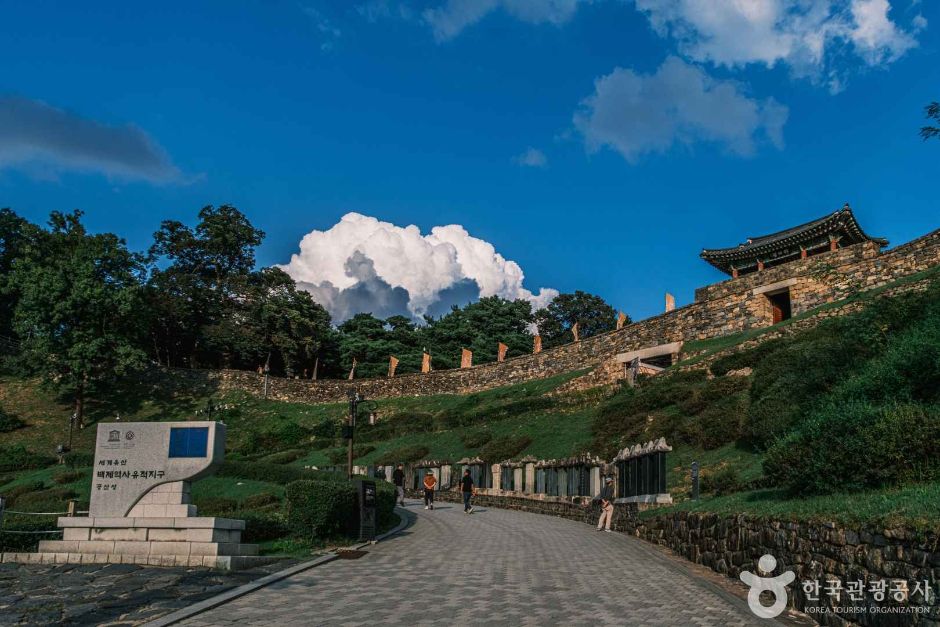
Gongju Gongsanseong Fortress (UNESCO)
공주 공산성Gongju Gongsanseong Fortress (UNESCO), Gongju, Chungnam, South Korea
Gongju Gongsanseong Fortress is a UNESCO World Heritage mountain rampart overlooking the Geumgang River, serving as the royal capital fortress of the ancient Baekje Kingdom (475–538 AD) during the ...
Morning (around 09:30-10:00)
Details→
Buyeo Busosanseong & Nakhwaam Rock
부여 부소산성 낙화암Buyeo Busosanseong & Nakhwaam Rock, Buyeo, Chungnam, South Korea
Buyeo Busosanseong Fortress and Nakhwaam Rock is a UNESCO World Heritage sanctuary along the Baengmagang River, famed for Nakhwaam ("The Rock of Falling Flowers"), the legendary rejuvenating spring...
Morning (around 09:30-10:00)
Details→
Asan Oeam Folk Village
아산 외암민속마을Asan Oeam Folk Village, Asan, Chungnam, South Korea
Asan Oeam Folk Village is an authentic 500-year-old living Joseon Dynasty clan hamlet, famed for 5.3 kilometers of mossy stacked stone walls, tile-roofed noble estates, thatched commoner cottages, ...
Morning (around 09:30-10:00)
Details→
Jeonju Hanok Village
전주한옥마을Jeonju Hanok Village, Jeonju, Jeonbuk, South Korea
Jeonju Hanok Village encompasses over 700 traditional Korean tiled homes nestled within the historic downtown core of Jeonju. Designated as an International Slow City, the village preserves authent...
Morning (around 09:30-10:00)
Details→